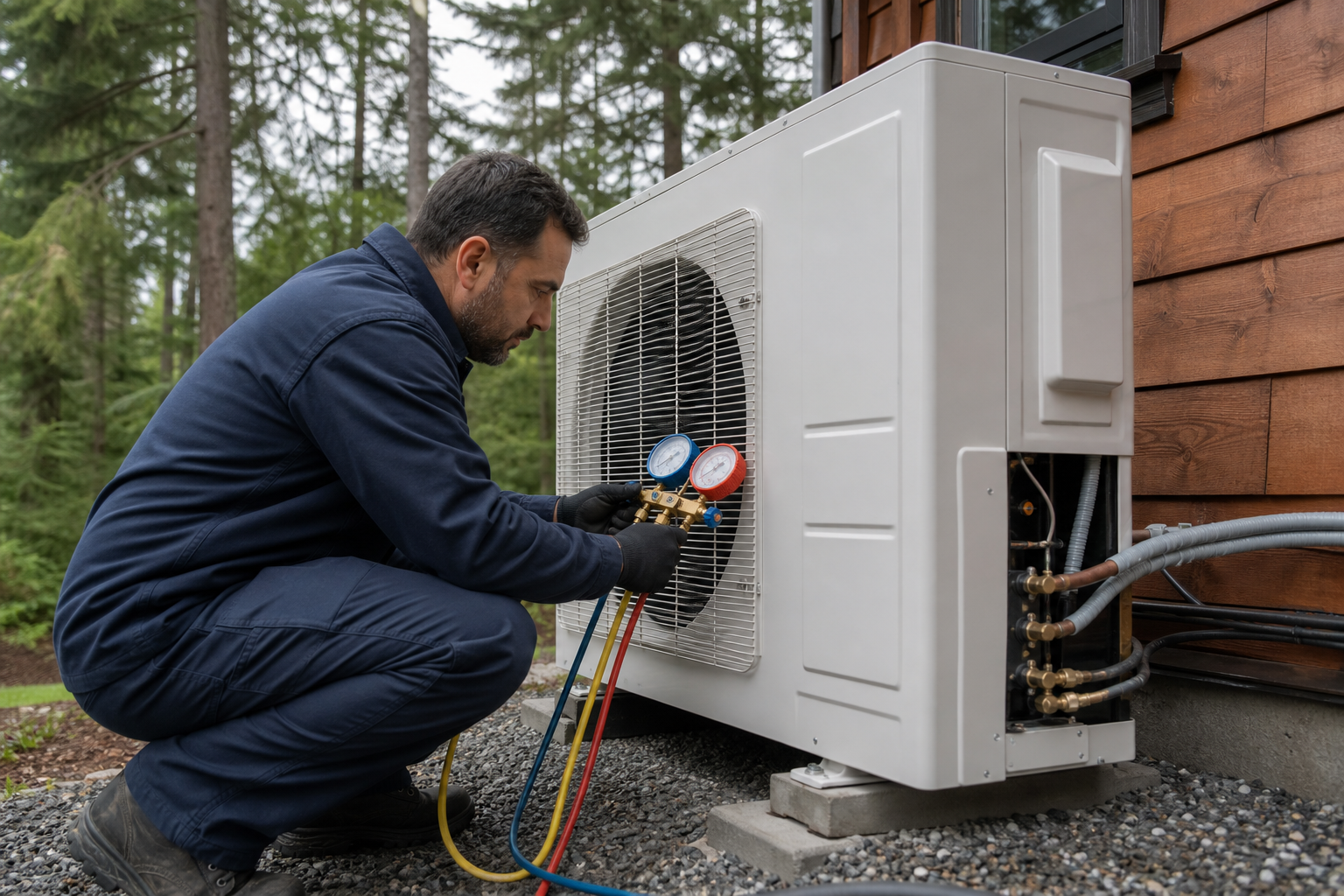
A boiler and a heat pump only look like rivals on a quote sheet. One heats water and sends it through pipes. The other, in the form most Burnaby houses actually install, heats air. The bill matters, and so does a duller question: can the radiators, the baseboard, or the floor you already paid for warm the rooms with cooler water? Premier Burnaby Heat Pump Installation gets asked this whenever a combi boiler or an old cast-iron unit is on its way out.
Two different heating plants
A boiler burns gas, or sometimes uses electricity, to heat water. A pump circulates that water through radiators, finned baseboard, or tubing in a floor. The room is warmed by the hot surface, with a little convection. There is no cooling. There is no ductwork. Zoning is genuinely good: a valve, a thermostat, a loop.
Combustion efficiency has a ceiling. A modern condensing boiler is rated around 95% AFUE, and it only earns that number when the water coming back is cool enough to condense the flue gas, roughly below 54°C. An older atmospheric cast-iron boiler, the kind still bolted to the floor in pre-war and mid-century houses, is often in the 70% to low-80% range, and short-cycling makes the seasonal number worse. No boiler turns one unit of gas into more than one unit of heat.
An air-source heat pump can clear that ceiling because the heat mostly comes from outdoor air. The compressor is the paid part. The same limits from the furnace comparison apply here, and the rate math is identical, so this page will use it and then spend its time on the piping, which is the part furnace articles skip. If your house is forced air, read heat pump vs furnace first.
The water temperature is the whole argument
Old radiators and a lot of residential baseboard were sized for hot water, often 70°C to 80°C on a design day. A floor poured in the last twenty years was usually sized for much cooler water, 30°C to 45°C, because the tubes cover so much area and because the people standing on it would rather it not scorch.
Standard air-to-water heat pumps are happy making 35°C to 50°C water. Some high-temperature models will push toward 65°C or so. The COP slides as the water gets hotter and as the outdoor air gets colder. At a high supply temperature on a -7°C Burnaby design morning, the COP can land near 2, sometimes lower. At that point you are close to the operating cost of a condensing boiler, and you paid a more expensive machine to get there.
Radiator output tracks the temperature difference between the water and the room, and it is steeper than a straight line. A panel or a column radiator sized for 80°C water in a 20°C room has about a 60 degree difference to work with. Feed it 45°C water and that difference is about 25 degrees. Output often falls to something like a third of the high-temperature rating. The house that was just warm enough at 80°C will be underheated at 45°C.
Two things reopen that door.
- The heat loss has dropped since the radiators were sized. New windows, attic insulation, and air sealing can cut the load enough that the old emitters are now oversized. Oversized emitters are exactly what a low-temperature heat pump wants.
- You add emitter. Extra panel radiators, deeper baseboard, or fan coils give the cooler water more surface. Fan coils also give you a path to cooling, which a radiator cannot do, because a cold radiator in summer just sweats and drips.
In-floor heat that was designed for low water temperature is the friendly case. The floor already is the low-temperature emitter. An air-to-water heat pump can often take the boiler's place and leave the manifolds alone, after someone checks flow, spacing, and the design water temperature on the original drawings. If those drawings are gone, the check is a heat loss plus a look at tube spacing.
Three ways people actually switch
Leave the pipes and change the air. This is the path we see most often in Burnaby houses with radiators and no ducts. A ductless heat pump, one outdoor unit and a few indoor heads, heats and cools the rooms people live in. The boiler can stay as backup for a winter, or come out. The radiators become furniture, or they come out too. You do not have to make 45°C water heat a 1912 column radiator. You also give up the feel of a warm radiant surface. Some people miss that more than they expected. Stand in the house on a cold evening before you decide the radiators are clutter.
Keep the water and change the boiler for an air-to-water heat pump. Right call when the emitters can do the job at the water temperature the heat pump can make efficiently. Low-temperature slabs, generously sized panel radiators, and houses that have been reinsulated are the candidates. Have the capacity checked at Burnaby's -7°C design temperature, at the supply temperature you intend to run, from the manufacturer's table. A nameplate that looks big at 7°C outdoor and 35°C water can be a different machine at -7°C outdoor and 55°C water.
Run both, on purpose. The heat pump carries spring, fall, and the mild stretches of winter. The boiler covers the design nights and, if it is a combi, the showers. You own two systems and you maintain two systems. It is rational when the boiler is new, the radiant comfort is non-negotiable, and the heat pump is there for cooling and for the mild-weather efficiency. It is an expensive way to avoid a decision when the boiler is already failing.
The hot water hidden inside the boiler
A lot of Lower Mainland renovations in the last fifteen years put in a combi boiler: space heat and domestic hot water from one wall-hung box. The reason people like them is the shower. A good combi holds a strong endless flow. Pull that box out and the heating question is only half the job.
You need a new plan for showers before the boiler leaves.
- A heat pump water heater makes hot water at a COP well above 1, and it cools and dehumidifies the room it sits in. That is a gift in a damp Burnaby basement and a problem in a closet that is also a cold-room. It needs condensate drainage, a volume of air, and a storage tank, so the shower is coming from the tank.
- An electric tank is simple and adds a large electrical load. On a full panel, this plus a space-heat heat pump is how a 100-amp service runs out.
- A small gas tank or tankless can stay, which keeps the gas meter and the daily basic charge. That is fine. Write it down so the "we disconnected gas" savings do not get counted twice.
Indirect tanks fired by the space-heat boiler have the same hole in the plan. The tank is only hot while the boiler is there to heat it.
The same 2026 rates, applied to water
FortisBC's Mainland variable gas cost is about $12.60 per gigajoule as of July 1, 2026, before tax: $8.469 delivery, $2.472 storage and transport, $1.660 commodity. The carbon tax is not in that number. It was removed April 1, 2025. The meter still costs $0.4216 a day if gas stays for anything.
BC Hydro is 11.87 cents per kWh on step 1 and 14.08 cents on step 2. Winter heating kilowatt-hours mostly land on step 2.
Delivered heat costs about 4.7 cents per kWh from a boiler that is truly running at 95%, about 5.3 cents if a "condensing" boiler is stuck on a high-temperature radiator circuit and seasons closer to 85%, and about 6.5 cents from an old boiler around 70%. A heat pump at COP 3 on step 2 power is about 4.7 cents. At COP 2, which is a plausible high-temperature, low-outdoor-temperature hour, it is about 7.0 cents.
So a new condensing boiler on a floor that lets it condense is neck and neck with a good heat pump on energy cost. An old cast-iron boiler is not. And the heat pump, if it is an air-to-air system or if fan coils are part of the air-to-water design, cools. The boiler never will. Burnaby's July design is only 25°C, with a 17°C wet bulb. The humidity is why upstairs bedrooms still get retrofit cooling on houses that "don't need air conditioning."
Use a scale, and label it as a scale. A house whose boiler burns 90 GJ a year for space heat at 70% seasonal efficiency has delivered about 17,500 kWh of heat. The gas variable cost is about $1,130. A COP 3 heat pump on step 2 power costs about $820 to deliver the same heat. Roughly $300 a year, plus cooling you did not have, plus whatever the rebate file is worth that year. Against a 95% boiler, that gas bill for the same delivered heat drops near $840 and the operating-cost story goes quiet. Comfort, cooling, the age of the boiler, and the electrical panel get the deciding vote.
Rebates are real and they are fussy. BC Hydro's published whole-home amount for replacing electric heat is $4,000 in the current program material, and $1,500 when the heat pump covers part of the home. Fossil-fuel conversions, air-to-water equipment, and the income-qualified CleanBC Energy Savings Program sit on different tables, and those tables have already moved in 2026. One primary space-heating rebate per home is the usual rule. Confirm the current sheet before equipment is ordered. A blog post is a bad place to lock a dollar figure you will apply for next spring.
Comfort, noise, and the thing radiators do well
Hydronic heat is quiet and even, and a warm floor is a different product from warm air. A heat pump head on the wall is quiet compared with a furnace, and it is still a fan in the room. The outdoor unit has a compressor and a fan. On a close Burnaby lot that sound has neighbours. Put it on a pad with a clear air path, mind the property line, and do not aim the fan at a bedroom window two metres away. If a strata or a neighbour constraint rules out an outdoor unit, the boiler conversation is over before the COP math starts.
Radiators also zone themselves room by room with almost no hardware. A single ducted heat pump does not, unless you add dampers. A multi-zone ductless system does, with a head or a cassette per area. Match the zoning you already like, or admit you are giving some of it up.
When the boiler should stay
Leave a sound boiler in place when the floor or the radiators need hot water to keep up, the boiler is young, and cooling is not on the list. A high-temperature air-to-water unit forced onto undersized cast-iron radiators will run at a poor COP and still leave the living room cool at -7°C. That is a bad trade.
Leave it in place, too, when the electrical service cannot take the heat pump and a new water heater, and a service upgrade is out of reach for now. An old boiler that is spilling flue gas, leaking, or running with an open draft hood in a tight renovated house is not a sentimental object. Those get replaced. The replacement might be a new condensing boiler, sized to the heat loss you have now, set up so the water is as cool as the emitters allow. Or it is a heat pump, once the emitters or the air distribution can accept it.
What to measure before you take the boiler out
You want the heat loss at -7°C, the water temperature the current system actually runs on a cold morning, and a straight look at whether the emitters can deliver that load at 40°C to 50°C. You want the hot water plan on the same page as the heating plan. You want the panel. If those four line up, an air-to-water heat pump is a clean swap and the radiant feel stays. If the radiators only work when the water is very hot, a ductless heat pump beside a retired boiler is usually the honest design, and the ducted vs ductless piece will help you picture the indoor units. If the boiler is really a furnace with ducts, you are on the wrong page.