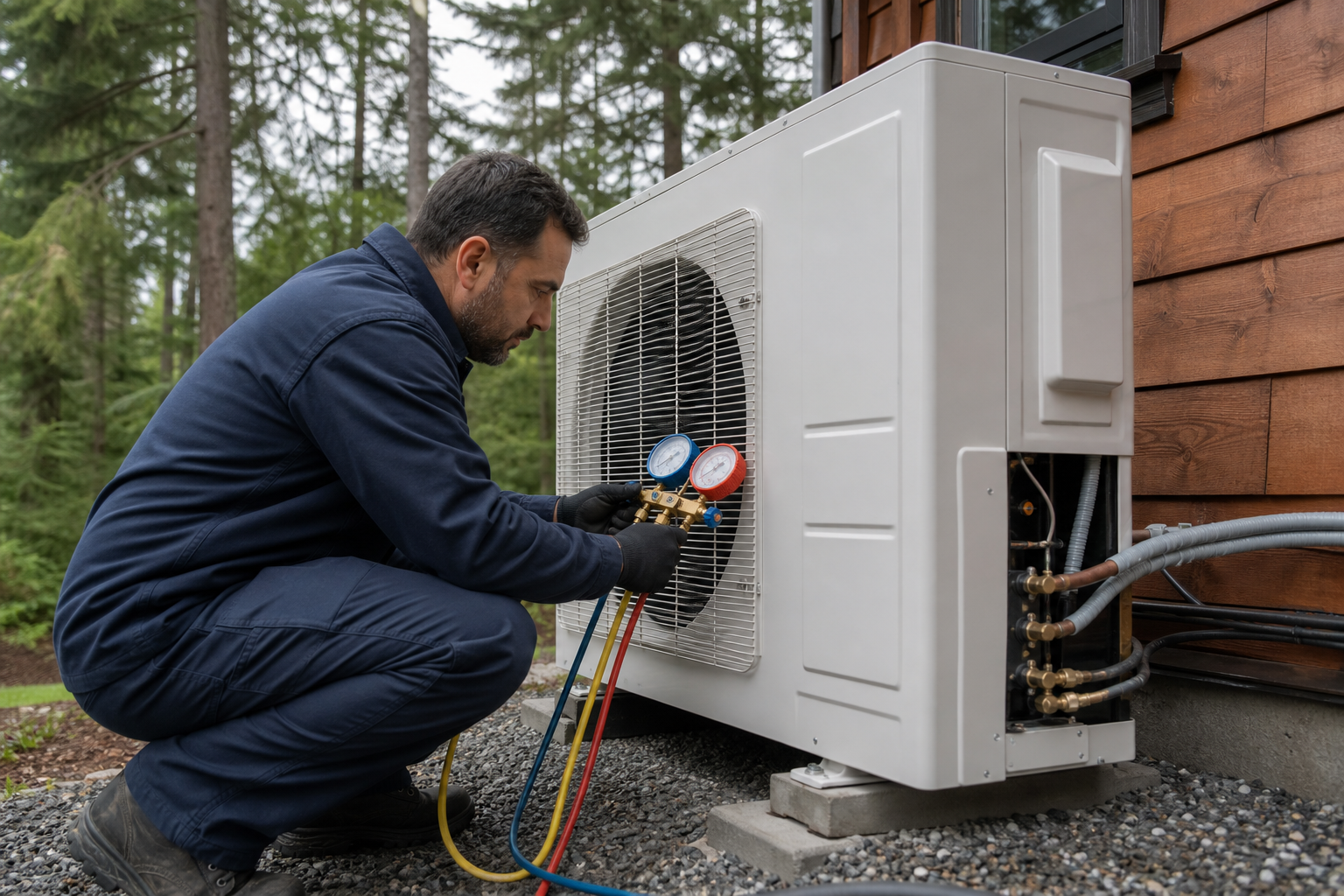
If you already have a gas furnace, the useful question is narrower than the ads make it. Will a heat pump heat this house on a wet Burnaby night, what will the energy actually cost at today's rates, and can the ducts you already own move enough air? Premier Burnaby Heat Pump Installation walks through that on site visits, because the answer changes with the furnace you have now.
What each machine is doing
A gas furnace burns natural gas, sends the hot combustion gas up a flue, and blows room air across a heat exchanger. The air that comes out of the registers is hot, often in the mid-50s Celsius on a cold day. Almost every joule of heat in the house was stored in the gas. A 96% furnace wastes about 4% of that fuel up the vent. An older mid-efficiency furnace, still common in Burnaby houses from the 1980s and 1990s, wastes closer to 20%.
A heat pump uses a refrigerant loop and a compressor to move heat from outdoor air into the house. In summer the same loop runs the other way and it becomes the air conditioner. One outdoor unit, one air handler or a set of indoor heads, heating and cooling from the same equipment. The electricity is paying the compressor to move heat. On a mild day a good unit moves about three units of heat for each unit of electricity. That ratio is the coefficient of performance, or COP. It falls as the outdoor air gets colder, because there is less heat outside to collect and the compressor is working harder.
Burnaby is a mild heating city, with a wet catch
The City of Burnaby's climatic data, aligned with the BC Building Code, puts the 2.5% January design temperature at -7°C and the 1% January temperature at -9°C. In plain language, a typical January is colder than -7°C for about 2.5% of its hours, on the order of 15 to 20 hours, and colder than -9°C for about 1% of January hours. Most of the city has about 2,735 heating degree-days below 18°C. The SFU area, higher up, is closer to 3,100. Same design extreme, more hours of heating.
That matters more than a brochure that says a unit "works to -30°C." Burnaby almost never asks a heat pump to do -30°C work. It does ask the outdoor coil to survive long stretches of damp air around freezing. Frost builds fastest in that band, roughly 0°C to 5°C with high humidity, which is a huge share of a Lower Mainland winter. The unit reverses into a defrost for a few minutes, melts the coil, and goes back to heating. That is normal. What is not normal is defrost water sheeting across a walkway and freezing, or a unit tucked under a deck where the melt has nowhere to go. Placement is part of the design, especially on the small lots in Capitol Hill, Brentwood, and the Hastings corridor.
A cold-climate heat pump is still the right spec here, for a boring reason. You want the capacity table at -7°C or -8°C, with the COP at that temperature, matched to a room-by-room heat loss. A unit that holds its output at -15°C will be comfortable in Burnaby. A bargain unit that has already lost half its capacity at -7°C will lean on electric strip heaters during the exact hours you bought it to avoid.
The bill, with the rates written out
People still repeat comparison math from Ontario gas prices or from the years when BC's carbon tax sat on the gas bill. The carbon tax is gone. BC eliminated the consumer carbon tax on April 1, 2025. Run the numbers on the tariff that is actually in force.
As of July 1, 2026, FortisBC's Mainland residential variable charges are $8.469 per gigajoule for delivery, $2.472 for storage and transport, and $1.660 for the gas itself. That is about $12.60 per gigajoule before tax. One gigajoule is about 278 kWh of raw energy. There is also a basic charge of $0.4216 per day, about $154 a year, for as long as the gas meter stays.
BC Hydro's residential tiered rate, confirmed by the BCUC for the same period, is 11.87 cents per kWh on step 1 and 14.08 cents on step 2. Step 1 covers roughly the first 22 kWh per day. A house that heats with a heat pump in January will spend most of those kilowatt-hours on step 2. The daily basic charge of about 23 cents is already on your electric bill if the house has power. It does not belong in the heat pump column.
Here is the cost of one kilowatt-hour of heat delivered into the house, before tax:
- A 96% furnace: about 4.7 cents. Almost all of the gas becomes heat.
- An 80% furnace: about 5.7 cents. This is the mid-efficiency equipment still sitting in a lot of Burnaby basements.
- A heat pump at a COP of 3.0 on step 2 power (14.08 cents): about 4.7 cents. A tie with the new condensing furnace.
- The same heat pump on a mild day at a COP of 3.5, if that power is still on step 1: about 3.4 cents.
- A cold night at a COP of 2.0 on step 2: about 7.0 cents. The furnace is cheaper for those hours.
The break-even COP against a 96% furnace is about 2.5 on step 1 power and about 3.0 on step 2. Against an 80% furnace it is about 2.1 to 2.5. A cold-climate unit in this marine climate commonly spends the bulk of its hours somewhere between a COP of 2.5 and 4. The seasonal average is what hits the bill. The design night is a handful of hours.
Put that on a house for scale. Say the furnace is 80% efficient and the gas utility shows about 80 GJ a year going to space heat, which is a plausible older detached house and a low number for a leaky one. That is about 17,800 kWh of heat actually arriving in the rooms. Replacing it:
- The gas variable cost is about $1,010 a year at $12.60 per GJ.
- A heat pump at a seasonal COP of 3.0, billed mostly at 14.08 cents, uses about 5,900 kWh and costs about $830.
- The gap is on the order of $150 to $200 a year. Real, and not a lifestyle change.
- If that same heat had been coming from electric baseboards, the step 2 bill would be about $2,500. The heat pump cuts that by roughly two thirds. That is the comparison where the operating cost shouts.
Against a new 96% furnace delivering the same 17,800 kWh, the gas variable cost falls to about $840. The heat pump at COP 3 on step 2 is a tie. If the seasonal COP lands at 2.5, the furnace is ahead by something like $150 a year. Anyone promising a slashed gas bill in Burnaby in 2026 is using someone else's rates.
The basic charge changes the picture only if the furnace is the last gas appliance. Keeping a gas range, a gas fireplace, or a gas water heater means you keep paying about $154 a year either way. Full disconnection saves that charge and removes the option of gas cooking and hot water. Price that on purpose.
The ducts were sized for a hotter airstream
This is the detail that decides a lot of Burnaby furnace replacements, and it rarely shows up in a phone quote.
A furnace can deliver its heat with a large temperature rise, so the ducts can be modest and the blower can be modest. A heat pump's supply air is often in the low-to-mid 30s Celsius once it is running steadily, sometimes warmer in turbo, rarely as hot as a furnace plenum. Heat delivered equals airflow times temperature rise. A smaller rise means more air. If the returns are undersized, the trunks are flattened, or a previous reno buried a duct in a bulkhead, the outdoor unit can be the right size and the house still falls behind on a cold morning.
You feel it as a system that runs all evening and never quite gets the back bedroom there, or as a whoosh at the register because the blower is forcing air through a tight duct. The fix is duct sealing, a proper return, a trunk upgrade, or abandoning the ducts for a ductless system. The City of Burnaby's air-source heat pump retrofit guide asks for a heat-loss calculation and, where ducts are involved, a duct layout. That paperwork exists because this failure mode is common.
There is a comfort side to the same physics. Furnace air feels hot at the register and then the burner shuts off. The house swings. Heat pump air feels milder and the system runs longer. Longer runs hold the temperature in a tighter band and, in summer, pull more moisture out of Burnaby's damp air. People who grew up with a furnace sometimes stand over a register in January, feel air that is only warm, and assume the system is broken. It is doing the job at a lower temperature, on purpose.
Cooling is included, and Burnaby uses it
A furnace does not cool. If you want summer comfort you buy a separate air conditioner and a coil on top of that furnace, with its own electrical circuit. July's 2.5% design condition in Burnaby is 25°C dry bulb and 17°C wet bulb. The thermometer is moderate. The wet bulb says the air holds moisture. Upper floors, west glass, and suites over garages are the rooms that get complained about.
A heat pump is the air conditioner and the heater. If you are already about to spend money on a new outdoor unit for cooling, the incremental step to a heat pump is often where the project starts to make sense, even when the winter bill versus a condensing furnace is a photo finish. The piece that pairs with this is heat pump vs air conditioner.
Power, permits, and the panel in the closet
A furnace needs a gas line and a small electrical circuit for the blower and the inducer. A heat pump needs a dedicated circuit that can be 20 to 40 amps or more, plus the air handler. A lot of North Burnaby houses still have 100-amp services, and some older panels are full. Range, dryer, EV charger, suite panel, heat pump: the load calc runs out of room, and a service upgrade lands in the quote. Find that out at the site visit.
BC requires permits for this work. Burnaby wants the heat loss done properly, and the electrical permit is separate from the building permit. Budget a few weeks around the install day for paperwork, longer in the busy spring.
Filters are the maintenance that actually changes how the system runs. A loaded filter drops airflow, and airflow was already the scarce resource. Outdoor coils need to stay clear of leaves and the lint that drifts off dryer vents. There is no heat exchanger to crack and no flue to spill combustion gas into the house. There is refrigerant, so the install has to be pressure-tested and evacuated by someone who does that every week. A sloppy lineset is how an efficient machine becomes an ordinary one by year three.
When the furnace is the better machine to keep
Keep the furnace, and repair it, when several of these are true at once.
- It is a recent condensing furnace, the heat exchanger is sound, and the ducts are quiet and warm every room.
- You have no interest in cooling, or you already added air conditioning and it is young.
- The electrical panel has no space and a service upgrade is a project of its own.
- You like very hot supply air and you do not want a longer, milder cycle.
- Gas is staying for hot water and cooking anyway, so the basic charge is a sunk cost, and the operating-cost gap is a couple of hundred dollars.
A furnace that is 15 to 20 years old, that short-cycles, or that has a cracked heat exchanger conversation already happening with your gas tech, is a different decision. So is an 80% furnace with a metal vent up a masonry chimney. Those are the replacements where a heat pump quote belongs next to a new furnace quote, on the same heat-loss number, with the duct work written as its own line.
A dual-fuel setup is a real third option
You can put a heat pump outdoor unit and coil on the furnace you already trust. The heat pump carries the mild hours, which in Burnaby is most of the winter. The furnace fires when the outdoor temperature drops through a balance point you choose, or during defrost if you want it to. You keep the gas meter. You gain cooling. You avoid living on electric strips if the panel is tight, because the furnace is the backup.
The tradeoff is two pieces of equipment to maintain, a control board that has to be set up for dual fuel, and a coil match that has to be listed. It is the right design for a large house with a good furnace and ducts that can take the extra airflow. It is a clumsy design for a house where the furnace is already at the end of its life. In that case, replace the whole plant once.
How to choose without a slogan
Ask for three numbers before you pick a side: the heat loss at -7°C, the heat pump's published capacity and COP at that temperature, and a duct or electrical note that says whether the house can deliver it. Then put the operating cost on step 2 power, against the efficiency of the furnace you actually own. An 80% furnace and a wish for cooling points toward the heat pump. A two-year-old 96% furnace and a full electrical panel points toward leaving it alone until it ages. The sizing guide on how big a heat pump needs to be is the next read if the capacity question is the one that feels fuzzy. If the house is on radiators or in-floor heat instead of ducts, you want heat pump vs boiler instead of this page.